Hydrotherapy for Scoliosis: Aquatic Therapy to Support Spinal Alignment
Scoliosis — an abnormal lateral curvature of the spine — affects approximately 2-3% of the population, with most cases diagnosed during adolescence. Whether you are managing a mild curve conservatively or recovering from spinal fusion surgery, the spine needs movement, but it needs the right kind of movement. Hydrotherapy provides an environment where you can strengthen spinal muscles, improve flexibility, and work on postural correction without the compressive forces that make land-based exercise uncomfortable or risky for curved spines.
Why Water Works for Scoliosis
A scoliotic spine is under asymmetric loading. The concave side of the curve bears more compressive force, while the convex side is stretched. On land, gravity amplifies these imbalances with every step. In water, the equation changes fundamentally.
When you stand in chest-deep warm water, buoyancy offloads approximately 80% of your body weight. This reduces the compressive forces on the spine dramatically, allowing you to work on posture, strength, and mobility with far less pain and risk of aggravating the curve.
Warm water (33-36°C) adds several additional benefits for scoliosis:
- Muscle relaxation on the concave side — The muscles on the concave (shorter) side of a scoliotic curve are typically tight and contracted. Warm water promotes muscle relaxation, reducing the guarding that can pull the curve tighter over time.
- Improved flexibility — Heat increases tissue extensibility, allowing deeper stretches of the restricted muscles and fascia along the curve. This is critical for conservative scoliosis management.
- Symmetrical resistance — Water provides resistance in all directions equally. Unlike gravity, which loads the spine asymmetrically in scoliosis, water allows you to perform symmetrical and targeted asymmetrical exercises with controlled resistance.
- Reduced inflammation — Hydrostatic pressure helps reduce swelling around irritated spinal structures, facet joints, and compressed nerve roots.
- Proprioceptive challenge — Water turbulence constantly challenges your balance and body awareness, training the deep postural muscles (multifidus, transversus abdominis, rotators) that are essential for spinal stability in scoliosis.
- Pain-free exercise — Many people with scoliosis avoid exercise because of pain or discomfort. The buoyancy and warmth of water make movement comfortable enough that they can perform a full exercise session — and adherence is the single most important factor in conservative scoliosis management.
What the Research Shows
Aquatic therapy for scoliosis has a growing evidence base, particularly for adolescent idiopathic scoliosis and post-operative rehabilitation.
A systematic review published in the Journal of Bodywork and Movement Therapies examined the effects of aquatic exercise on spinal conditions, including scoliosis. The researchers found that water-based exercise programmes improved pain, function, and quality of life, with the buoyancy-supported environment allowing patients to perform spinal exercises that would be too painful or difficult on land [1].
A 2014 review in the North American Journal of Medical Sciences confirmed that hydrotherapy positively affects the musculoskeletal system, noting that warm water immersion reduces muscle tension, joint stiffness, and pain perception — all relevant to scoliosis management [2].
The 2023 meta-analysis of 32 randomised controlled trials in the Journal of Orthopaedic Surgery and Research involving over 2,200 participants with chronic musculoskeletal conditions concluded that aquatic exercise significantly reduces pain and improves physical function, with better adherence than land-based alternatives [3].
Research on Schroth-based exercise — the gold standard for scoliosis-specific physiotherapy — has shown that these principles can be effectively adapted to an aquatic environment. The water provides natural resistance for the corrective movements while the buoyancy supports the spine during the challenging postural corrections that Schroth requires.
Hydrotherapy Exercises for Scoliosis
These exercises should be performed in warm water (33-36°C). Ideally, work with a physiotherapist who can tailor the exercises to your specific curve pattern (direction, location, severity). The exercises below are general principles — your programme may need to emphasise different muscles depending on whether you have a thoracic curve, lumbar curve, or double curve.
Warm-Up (5-10 minutes)
- Water walking with postural focus — Walk forward, backward, and sideways in chest-deep water. Concentrate on standing as tall as possible with shoulders level and hips square. The water provides feedback — if you lean or twist, you feel the resistance change. 5 minutes.
- Arm sweeps — Stand with arms at your sides. Sweep both arms forward and up to shoulder height, then sweep them back. Focus on keeping your trunk stable and symmetrical. 2 minutes.
- Gentle trunk rotation — Arms extended at the water surface. Slowly rotate your upper body left and right, keeping hips facing forward. 10 each direction.
Spinal Elongation and Decompression
- Vertical hang — In deep water, hold the pool edge with both hands and let your body hang vertically. Allow gravity and buoyancy to gently decompress your spine. Breathe deeply. Hold for 1-2 minutes. This is one of the most therapeutic positions for scoliosis — the spine can elongate without any compressive load.
- Streamlined floating — Float on your back with arms extended overhead, body in the longest possible position. Use a pool noodle for support if needed. Focus on making yourself as long and symmetrical as possible. 2-3 minutes. This trains spinal elongation and body awareness.
- Supine flutter kick — Float on your back (noodle under shoulders for support). Gentle flutter kick while maintaining a long, straight body position. 2 minutes. Combines spinal elongation with gentle core activation.
Core Stabilisation
- Standing single-leg lifts — Stand in chest-deep water. Slowly lift one knee toward your chest while maintaining upright posture. Hold 5 seconds. 10 each side. The water resistance challenges your core while buoyancy supports your spine.
- Dead bug (aquatic version) — Float on your back with noodle support. Extend one arm overhead while extending the opposite leg. Return to centre. Alternate sides. 10 each side. This teaches cross-body coordination and core stability — both critical for managing scoliosis.
- Plank hold on pool wall — Hold the pool edge with straight arms, body floating behind you in a horizontal plank position. Hold 20-30 seconds. 3 sets. Water buoyancy makes this more accessible than a land-based plank while still engaging the full core.
Curve-Specific Strengthening
- Convex-side arm reach — Stand with the convex side of your curve facing the pool wall. Reach the arm on the convex side up and over toward the wall, creating a stretch on the concave side and strengthening the convex side. Hold 10 seconds. 10 repetitions. This mimics the corrective side-shift used in Schroth therapy.
- Side-lying kicks — Float on the concave side with noodle support. Kick the top leg forward and back in controlled movements. 15 repetitions. This strengthens the muscles on the convex side of the curve, helping to rebalance the asymmetrical muscle forces.
- Asymmetric backstroke — Swim backstroke but emphasise the pulling motion on the weaker (convex) side. This builds unilateral strength to counteract the muscular imbalance created by the curve.
Breathing and Rib Mobilisation
- Directional breathing — Stand in chest-deep water. Place one hand on the concave side of your rib cage. Breathe deeply, directing the breath into that hand, trying to expand the compressed ribs. The hydrostatic pressure from the water provides gentle resistance that trains the intercostal muscles. 10 deep breaths.
- Rib cage rotation stretch — Stand with arms extended at the water surface. Rotate your trunk slowly, focusing on opening the compressed side of the rib cage. Hold the stretched position for 10 seconds. 5 each direction.
Cool-Down (5 minutes)
- Floating relaxation — Float on your back with full noodle support. Close your eyes and focus on breathing deeply. Let the water support your spine completely. 3 minutes.
- Gentle side stretches — Stand upright, reach one arm overhead and lean gently to the opposite side. Hold 20 seconds each side. 2 repetitions.
Scoliosis Types and Water Therapy Approaches
Adolescent Idiopathic Scoliosis (Mild: Under 25°)
For mild curves, aquatic exercise focuses on core strengthening, postural awareness, and maintaining flexibility. The goal is to prevent curve progression through strong, balanced trunk muscles. Swimming itself is excellent — it strengthens the back extensors symmetrically without spinal compression. Aquatic exercise programmes 2-3 times per week can complement bracing protocols effectively.
Moderate Curves (25-45°)
Moderate curves require more targeted, asymmetrical exercises to address the specific muscle imbalances of the curve pattern. Aquatic Schroth-based exercises — adapted corrective movements performed in water — combine the benefits of the gold-standard physiotherapy approach with the supportive environment of the pool. Work with a scoliosis-trained physiotherapist to design your programme.
Post-Surgical Scoliosis (After Spinal Fusion)
Once wounds are healed and your surgeon clears you for pool exercise (typically 6-12 weeks post-surgery), aquatic therapy is invaluable for rehabilitation. The fused segments of your spine cannot move, so the exercises focus on strengthening the muscles around the fusion, maintaining mobility in the unfused segments, and rebuilding cardiovascular fitness. Water buoyancy makes early post-operative movement possible before land-based exercise is comfortable.
Degenerative Scoliosis (Adult)
Degenerative scoliosis develops in adulthood due to disc degeneration and facet joint changes. Pain management is typically the primary goal. Warm water immersion and gentle aquatic exercise address both — the warmth reduces pain and muscle tension, while the exercise maintains spinal mobility and strength. Many adults with degenerative scoliosis find aquatic exercise is the only form of exercise they can tolerate comfortably.
Home-Based Water Therapy for Scoliosis
- Warm bath soaks — 15-20 minutes in a warm bath (37-39°C) with Epsom salts relaxes the tight muscles on the concave side of the curve. While soaking, practise directional breathing exercises to expand the compressed rib cage.
- Contrast showers — Alternate warm and cool water directed at the paraspinal muscles along your curve. 2 minutes warm, 30 seconds cool, repeated 3-4 times. This promotes circulation and reduces muscle tension.
- Community pool sessions — Even without formal aquatic therapy, 30 minutes of swimming (especially backstroke) and pool walking 2-3 times per week provides meaningful exercise for scoliosis management.
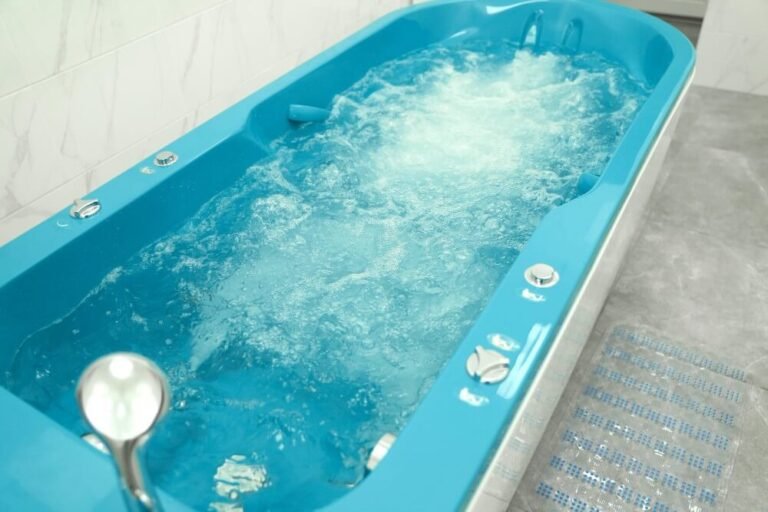
- Hot tub or hydrotherapy tub — Jets directed at tight paraspinal muscles provide hydro-massage that loosens contracted tissue along the curve.
When to Avoid Hydrotherapy for Scoliosis
- Immediately after surgery — Do not enter a pool until your surgeon explicitly clears you. The surgical incision must be fully healed, and spinal fusion needs time to consolidate. Premature pool exercise can risk infection or hardware complications.
- Active spinal infection — Any infection in or around the spine (discitis, osteomyelitis) requires medical treatment, not water therapy.
- Unstable fracture — If you have a vertebral fracture (compression or otherwise), follow your medical team’s guidance on when aquatic exercise is safe.
- Uncontrolled pain — If your scoliosis pain is severe and uncontrolled, address pain management with your doctor first. Hydrotherapy should supplement a pain management plan, not replace it.
Frequently Asked Questions
Can swimming help scoliosis?
Yes. Swimming is one of the most commonly recommended exercises for scoliosis because it strengthens the back muscles symmetrically without compressive spinal loading. Backstroke is generally preferred because it promotes spinal extension and symmetrical muscle activation. However, swimming alone does not correct a curve — it should be part of a comprehensive exercise programme that includes curve-specific strengthening and postural training. Aquatic exercises tailored to your specific curve pattern are more targeted than swimming laps.
How often should someone with scoliosis do aquatic therapy?
Research protocols typically use 2-3 sessions per week over 8-12 weeks to achieve measurable improvements in pain, function, and sometimes Cobb angle. Each session lasts 30-45 minutes. Consistency matters more than intensity. Many physiotherapists recommend continuing with 1-2 maintenance sessions per week indefinitely, as scoliosis is a lifelong condition that benefits from ongoing management.
Is hydrotherapy safe for children with scoliosis?
Yes. Aquatic therapy is safe and well-tolerated for children and adolescents with scoliosis. The warm water environment often makes exercise more enjoyable for younger patients, improving adherence to their treatment programme. For adolescents wearing a brace, pool sessions provide a welcome break from bracing while still working on the spinal muscles. Work with a paediatric physiotherapist experienced in scoliosis for age-appropriate exercise programming.
Can hydrotherapy reduce a scoliosis curve?
Hydrotherapy alone is unlikely to reduce an established structural curve significantly. However, it can improve the functional component of the curve — the portion caused by muscle imbalance and tightness rather than bony deformity. In mild curves, comprehensive exercise programmes (including aquatic components) have been shown to slow or halt curve progression, which is a meaningful clinical outcome. The primary benefits are pain reduction, improved function, better posture, and prevention of further progression.
Related Reading
- Hydrotherapy for Back Pain
- Hydrotherapy for Herniated Disc and Spinal Stenosis
- 12 Hydrotherapy Exercises for Pain Relief and Recovery
- Hydrotherapy for Health Conditions A-Z
Always consult your orthopaedic specialist or physiotherapist before starting a hydrotherapy programme for scoliosis, especially if you have had spinal surgery or wear a brace. See our Medical Disclaimer.
Sources
[1] Journal of Bodywork and Movement Therapies. Effects of aquatic exercise on spinal conditions: A systematic review. doi:10.1016/j.jbmt.2020.06.003
[2] Mooventhan, A., & Nivethitha, L. (2014). Scientific Evidence-Based Effects of Hydrotherapy on Various Systems of the Body. North American Journal of Medical Sciences, 6(5), 199-209.
[3] Journal of Orthopaedic Surgery and Research (2023). Efficacy of aquatic exercise in chronic musculoskeletal disorders: A meta-analysis of 32 randomized controlled trials.