How Hydrotherapy Machines Actually Work: The Physics and Physiology Behind Every Claim
Every hydrotherapy product makes claims — pain relief, better circulation, faster recovery, deeper relaxation. But few explain how water actually produces these effects, or whether a particular machine even uses the relevant mechanism.
Understanding the physics changes everything. Once you know why water works differently from air, you can evaluate any hydrotherapy product on its merits rather than trusting marketing language. This guide explains the four properties of water that matter therapeutically, maps each machine type to the properties it actually uses, and cites the physiological measurements that prove (or disprove) common claims.
The Four Properties of Water That Matter
Water has four physical properties that distinguish it from air as a therapeutic medium. Every legitimate hydrotherapy benefit traces back to one or more of these.
1. Buoyancy: Joint Unloading
Archimedes’ principle: a body immersed in water experiences an upward force equal to the weight of water displaced. Because the average human body density (~950 kg/m³) is close to water (1,000 kg/m³), immersion dramatically reduces effective body weight.
Torres-Ronda and Schelling (2014, Journal of Human Kinetics) compiled the research on body weight offloading at different immersion depths:
| Immersion Depth | Body Weight Offloaded | Practical Example |
|---|---|---|
| Waist (umbilicus) | ~50% | A 90 kg person experiences load of ~45 kg |
| Chest (xiphoid process) | ~60% | A 90 kg person experiences load of ~36 kg |
| Shoulders | ~85% | A 90 kg person experiences load of ~14 kg |
| Neck (C7 vertebra) | 90–94% | A 90 kg person experiences load of ~6–9 kg |
Research using instrumented joint implants has shown that joint forces during water-based activities are reduced by 36–55% compared to the same activities on land, with absolute reductions exceeding 100% of body weight during dynamic movements (Kutzner et al., 2017, PLOS ONE).
What this means for machines: Only devices that immerse a significant portion of your body provide buoyancy benefits. A hydrotherapy shower, foot spa, or water massage bed does not. A hot tub or pool does. This single distinction eliminates most of the claims made about non-immersion devices.
2. Hydrostatic Pressure: Blood Redistribution
Water exerts pressure on every surface of an immersed body, increasing with depth (approximately 1 mmHg per 1.36 cm of water depth). At chest-deep immersion, this amounts to roughly 80 mmHg on the lower limbs.
Weenink and Wingelaar (2021, Frontiers in Physiology) reviewed the circulatory effects and found that immersion to the neck centralises approximately 500–700 ml of blood from the periphery to the thorax. This increases cardiac volume by 30–35% — essentially, your heart receives more blood to pump with each beat.
However, these researchers also corrected a common misconception: hydrostatic pressure does not function as external compression the way a compression garment does. The pressure is transmitted equally through all tissues — there is no net pressure gradient between blood vessels and surrounding tissue. The circulatory benefit comes from buoyancy counteracting gravity (reducing fluid pooling in the legs), not from the water squeezing blood upward.
What this means for machines: You need full or near-full body immersion to get meaningful hydrostatic effects. Partial immersion (foot baths, arm baths) produces localised effects only. Water jets do not add hydrostatic pressure — they add mechanical force to the skin surface, which is a completely different mechanism.
3. Thermal Conductivity: 25 Times More Efficient Than Air
Water transfers heat approximately 25 times faster than air (thermal conductivity: water 0.58 W/m·K vs air 0.024 W/m·K). Combined with water’s higher specific heat capacity (4.18 kJ/kg·K vs air’s 1.01 kJ/kg·K) and density, this means water can deliver or extract heat from the human body far more rapidly than any air-based therapy.
This is why a 15°C room feels chilly but manageable, while 15°C water feels intensely cold — and why a 38°C bath feels much warmer than 38°C air.
Šrámek et al. (2000, European Journal of Applied Physiology) measured the physiological responses to one-hour head-out immersion at three temperatures in healthy volunteers:
| Measurement | 32°C (Thermoneutral) | 20°C (Cool) | 14°C (Cold) |
|---|---|---|---|
| Heart rate change | −15% | −15% (similar) | +5% |
| Blood pressure change | −11–12% | Similar decrease | +7–8% |
| Metabolic rate change | No change | +93% | +350% |
| Plasma cortisol | −34% | Tended to decrease | No significant change |
| Plasma noradrenaline | No significant change | Not reported | +530% |
| Plasma dopamine | Not reported | Not reported | +250% |
| Diuresis (urine output) | +107% | +89% | +163% |
The data shows that warm water (32°C) reduces heart rate, blood pressure, and cortisol — the classic “relaxation response.” Cold water (14°C) triggers the sympathetic nervous system instead, massively increasing metabolic rate and stress hormones. These are opposite physiological states, not variations of the same thing. For a detailed look at how athletes use cold and contrast water therapy, see our guide to extreme hydrotherapy for recovery.
What this means for machines: Temperature is arguably the most important variable in hydrotherapy, and it determines which effect you get. A machine’s ability to control and maintain temperature is more important than its jet configuration, brand name, or number of features. A £30 bath thermometer may be more therapeutically relevant than a £300 jet upgrade.
4. Viscosity and Resistance: The Exercise Effect
Water is approximately 800 times denser than air. Moving through water requires overcoming three types of resistance: shape resistance (pressure drag), wave resistance (surface turbulence), and frictional resistance (skin contact with water molecules).
This resistance increases exponentially with movement speed, making water a natural progressive resistance environment. Research shows that aquatic exercise elevates VO₂ (oxygen consumption) and heart rate above land values for the same perceived effort, meaning the same movement burns more energy in water (Torres-Ronda & Schelling, 2014).
Ground reaction forces during aquatic plyometric exercise are reduced by 45–60% compared to land-based equivalents, while maximum force and power output remain comparable (Donoghue et al., 2011; Robinson et al., 2004). This makes water an ideal medium for high-intensity training with reduced joint stress.
What this means for machines: Viscosity benefits require you to move through water. Sitting in a hot tub provides buoyancy and thermal benefits but minimal resistance benefit. Underwater treadmills and aquatic exercise pools exploit this property. Hot tubs do not.
What Each Machine Type Actually Uses
Every hydrotherapy machine exploits some combination of these four properties. The table below maps each common device to the physics it actually engages — not what the marketing suggests, but what the design permits.
| Machine Type | Buoyancy | Hydrostatic Pressure | Thermal Transfer | Viscosity/Resistance |
|---|---|---|---|---|
| Hot tub / spa (seated) | Partial (waist–chest) | Partial | Yes (full immersion) | No (stationary) |
| Swim spa / therapy pool | Yes (full) | Yes | Yes | Yes (if exercising) |
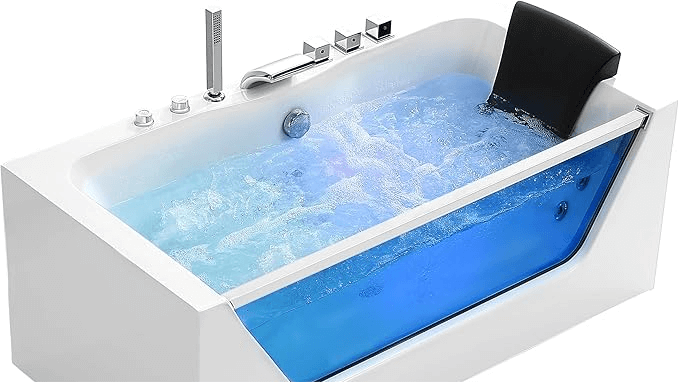
| Whirlpool bath | Partial (reclined) | Partial | Yes | No (stationary) |
| Hydrotherapy shower | No | No | Minimal (surface only) | No |
| Water massage bed | No | No | Some (through membrane) | No |
| Underwater treadmill | Yes | Yes | Yes | Yes (primary purpose) |
| Foot spa | No (feet only) | Negligible | Localised | No |
| Cold plunge / ice bath | Yes (full) | Yes | Yes (cold extraction) | No (stationary) |
| Floatation tank | Yes (supine) | Yes | Thermoneutral (minimal) | No |
This table reveals a pattern that marketing obscures: most of the more expensive “hydrotherapy machines” — showers, water massage beds, foot spas — use fewer of water’s therapeutic properties than a standard bathtub with temperature control.
How Jets Work — And What They Cannot Do
Water jets are the primary selling point for hot tubs, whirlpool baths, and hydrotherapy showers. Understanding what they actually do helps separate useful features from expensive decoration.
A water jet directs a stream of water at the body surface. It does two things:
- Mechanical pressure on the skin. This stimulates mechanoreceptors and can produce a massage-like sensation. Higher jet pressure increases this effect but can also cause discomfort or bruising.
- Convective heat transfer. Moving water past the skin prevents formation of an insulating boundary layer of still water. This means the body absorbs (or loses) heat faster from agitated water than from still water at the same temperature. This is the most therapeutically relevant function of jets.
What jets cannot do:
- Reach deep tissue. Water pressure dissipates rapidly through skin and subcutaneous fat. Jets cannot reach muscles at depth the way a physiotherapist’s hands can through sustained, targeted pressure.
- Add hydrostatic pressure. Jets push water against one area of skin; hydrostatic pressure acts equally on every surface simultaneously. These are different physics.
- Substitute for exercise. The mechanical sensation feels active, but sitting in a jet stream does not engage muscles or produce the metabolic benefits of movement through water.
- “Flush toxins” or “break up cellulite.” There is no evidence supporting these common marketing claims.
A hot tub with 20 jets is not necessarily more therapeutic than one with 6 jets. Beyond a basic level of water circulation (which improves heat distribution), additional jets provide sensory variety rather than measurably different therapeutic outcomes.
The Temperature Variable: Why It Matters More Than the Machine
The Šrámek et al. (2000) data demonstrates something most hydrotherapy marketing ignores: temperature is the dominant variable determining what happens to your body during water immersion.
A simple bathtub at 38°C will lower your heart rate, blood pressure, and cortisol. A £10,000 hot tub at the same temperature will do the same — the physics doesn’t change because the machine is more expensive.
Conversely, using a £10,000 hot tub at too high a temperature (above 40°C) introduces cardiovascular strain that may outweigh any relaxation benefit, regardless of how many jets it has.
Temperature ranges and their primary effects based on available evidence:
| Temperature Range | Dominant Response | Key Effects | Duration Guidance |
|---|---|---|---|
| 10–15°C | Sympathetic activation | Metabolic rate ↑350%, noradrenaline ↑530% | 2–5 minutes maximum |
| 15–20°C | Moderate sympathetic | Metabolic rate ↑93%, blood pressure stable | 5–15 minutes |
| 30–34°C | Thermoneutral / parasympathetic | HR ↓15%, BP ↓11–12%, cortisol ↓34% | 15–60 minutes |
| 36–38°C | Warm / parasympathetic | Muscle relaxation, vasodilation, sleep promotion | 15–30 minutes |
| 38–40°C | Hot / cardiovascular demand | Strong vasodilation, increased cardiac output | 10–20 minutes (caution) |
| Above 40°C | Heat stress | Risk of hypotension, dizziness, dehydration | Medical supervision advised |
The practical implication: before upgrading your hydrotherapy machine, consider whether you have accurate temperature control and a reliable thermometer. These matter more than jet count, brand name, or LED lighting.
Machine-by-Machine: Physics Applied
Using the physics framework above, here is what each common machine type actually delivers.
Hot Tubs and Spas
Physics engaged: Partial buoyancy (seated position, typically waist to chest immersion), hydrostatic pressure on lower body, thermal transfer (primary mechanism), jet agitation for convective heat transfer.
What happens physiologically: At 36–38°C, expect heart rate and blood pressure reduction, cortisol decrease, peripheral vasodilation, and increased diuresis. The Šrámek data at 32°C showed cortisol reduction of 34% — warmer water may amplify this but also increases cardiovascular demand.
Limitations: Buoyancy is limited by seated depth. You don’t get the 85–90% weight offloading available at shoulder or neck immersion. Exercise capacity is minimal (you’re sitting). The primary therapeutic value is thermal, not mechanical.
Whirlpool Baths
Physics engaged: Similar to hot tubs but with reclined posture allowing greater body surface area immersion. Jet agitation prevents the thermal boundary layer, improving heat transfer efficiency.
What happens physiologically: Essentially the same as a hot tub, with slightly more uniform heat distribution due to water agitation. Clinical whirlpool baths are used in wound care and rehabilitation, though a Cochrane-style review (Mooventhan & Nivethitha, 2014) noted that evidence for whirlpool-specific benefits over standard warm immersion remains limited.
Limitations: The difference between a whirlpool bath and a standard bath at the same temperature is the jet agitation — which primarily affects heat distribution and skin stimulation. For relaxation purposes, the thermal effect dominates in both cases.
Hydrotherapy Showers
Physics engaged: Thermal transfer only (and limited, since water contact is brief and partial). No buoyancy. No hydrostatic pressure. No viscosity resistance.
What happens physiologically: Warm water on the skin surface produces localised vasodilation and sensory stimulation. Alternating hot and cold shower exposure can trigger cardiovascular responses, but these are surface-level compared to full immersion. There is no evidence that shower-based hydrotherapy produces the deep physiological changes (cortisol reduction, cardiac output changes) seen with immersion.
Limitations: A hydrotherapy shower is fundamentally different from immersion hydrotherapy. It uses only one of water’s four therapeutic properties, and uses it partially. Marketing that equates shower systems with spa or bath hydrotherapy is misleading.
Water Massage Beds
Physics engaged: Mechanical pressure through a membrane. Some thermal transfer through the membrane material. No buoyancy. No hydrostatic pressure. No immersion.
What happens physiologically: Rhythmic pressure on the back surface produces sensory stimulation and may help with superficial muscle tension. However, you are not actually in water — you are lying on a membrane while water moves beneath you. None of the immersion-related physiology (blood redistribution, cardiac output changes, cortisol reduction from hydrostatic effects) applies.
Limitations: Despite the “hydro” label, water massage beds are massage devices that use water as their mechanical medium. They are not hydrotherapy in the physiological sense. This does not make them useless — but claims about “hydrotherapy benefits” from a water massage bed are unsupported by the immersion research.
Underwater Treadmills
Physics engaged: All four properties — buoyancy (reduces joint loading by 36–55%), hydrostatic pressure (aids circulation during exercise), thermal transfer (environment temperature control), and viscosity resistance (the primary purpose — water provides progressive resistance to movement). For a full guide to how these devices work and who they help, see our underwater treadmill guide.
What happens physiologically: The combination of reduced joint loading and increased resistance allows exercise that is simultaneously lower-impact and higher-effort. Research shows that aquatic treadmill walking produces higher oxygen consumption per stride than land treadmill walking at the same speed, meaning more metabolic work with less joint stress.
Limitations: Underwater treadmills are clinical or high-end athletic equipment, typically costing £15,000–£40,000+. They are designed for rehabilitation and athletic training, not home relaxation. For most people, an aquatic exercise class in a local pool achieves the same physics at a fraction of the cost.
Common Claims vs Physical Reality
| Marketing Claim | Physical Reality | Verdict |
|---|---|---|
| “Jets provide deep tissue massage” | Water pressure dissipates through skin; jets reach surface only | Misleading |
| “Improves circulation” | True for immersion (blood redistribution), but not for showers or water massage beds | Depends on the machine |
| “Flushes toxins” | No evidence. Increased diuresis occurs but is a hydrostatic pressure response, not detoxification | Unsupported |
| “More jets = better therapy” | Beyond basic water circulation, extra jets add sensory variety, not measurable therapy | Marketing |
| “Burns calories passively” | Warm immersion does not meaningfully increase metabolic rate. Cold immersion does (+93–350%) | Misleading (unless cold) |
| “Reduces joint pain” | True for immersion (buoyancy offloading), supported by systematic reviews of aquatic exercise | Supported for immersion |
| “Better than a bath” | Depends entirely on depth of immersion and temperature control, not the machine’s complexity | Often false |
For a detailed analysis of what clinical trial participants actually report — versus what marketing promises — see our guide to hydrotherapy tub research outcomes.
What to Actually Look for When Buying
Based on the physics, here is what matters when evaluating any hydrotherapy device (for a full decision framework, see our evidence-based equipment guide):
- Immersion depth. The deeper the immersion, the more of water’s properties you access. A device that immerses you to the chest engages buoyancy, hydrostatic pressure, and thermal transfer. One that sprays water on your skin engages thermal transfer partially.
- Temperature control. The ability to set and maintain a specific temperature is the single most therapeutically important feature. A £5,000 hot tub with poor temperature regulation is less useful than a £3,000 one with accurate ±0.5°C control.
- Insulation and energy efficiency. This determines whether you can maintain your target temperature affordably. A well-insulated hot tub at 38°C costs significantly less to run than a poorly insulated one — and temperature consistency matters for the physiological response.
- Size for your intended use. If you want relaxation (thermal + buoyancy), you need enough depth to immerse to chest level. If you want exercise, you need enough space to move. Neither requires 60 jets.
- Hygiene systems. Clean water is a prerequisite for all benefits. Filtration, sanitation, and maintenance requirements are practical priorities that many buyers undervalue relative to jet count or LED lighting.
Key Takeaways
- Water’s therapeutic effects come from four properties: buoyancy (reduces body weight by up to 90% at neck depth), hydrostatic pressure (redistributes ~500–700 ml of blood centrally), thermal conductivity (25× more efficient than air), and viscosity (800× denser than air, providing natural resistance).
- Temperature is the dominant variable. At 32°C, Šrámek et al. (2000) measured heart rate reduction of 15%, blood pressure reduction of 11–12%, and cortisol reduction of 34%. At 14°C, the same study found metabolic rate increased 350% and noradrenaline increased 530% — completely opposite physiological states.
- Most “hydrotherapy” devices use fewer of water’s properties than a standard bathtub. Showers, water massage beds, and foot spas miss buoyancy, hydrostatic pressure, and often adequate thermal transfer. A full bath at a controlled temperature is more physiologically effective than many expensive branded alternatives.
- Jets primarily improve heat distribution, not deep tissue therapy. Water pressure dissipates at the skin surface. Beyond basic water circulation, additional jets provide sensory variety rather than measurable therapeutic improvement.
- Immersion depth and temperature control are the two features that matter most. Every other specification — jet count, LED lighting, brand name, Bluetooth speakers — is secondary to the physics that actually produces physiological change.
Related Reading
- Hydrotherapy Equipment: An Evidence-Based Decision Framework
- Every Hydrotherapy Product Ranked by Evidence
- Hydrotherapy for Relaxation: What Each System Does to Your Nervous System
- What Research Participants Actually Report About Hydrotherapy Tubs
References
- Šrámek, P. et al. (2000). Human physiological responses to immersion into water of different temperatures. European Journal of Applied Physiology, 81(5), 436–442.
- Weenink, R.P. & Wingelaar, T.T. (2021). The circulatory effects of increased hydrostatic pressure due to immersion and submersion. Frontiers in Physiology, 12, 699493.
- Torres-Ronda, L. & Schelling i del Alcázar, X. (2014). The properties of water and their applications for training. Journal of Human Kinetics, 44, 237–248.
- Kutzner, I. et al. (2017). Does aquatic exercise reduce hip and knee joint loading? PLOS ONE, 12(3), e0171972.
- Donoghue, O.A. et al. (2011). Impact forces during plyometric exercises in water and on land. Journal of Science and Medicine in Sport, 14(5), 295–300.
- Mooventhan, A. & Nivethitha, L. (2014). Scientific evidence-based effects of hydrotherapy on various systems of the body. North American Journal of Medical Sciences, 6(5), 199–209.